Banknotes
Canada’s New $20 Banknote Promises Three-Dimensionality, Fluid Movement
The Bank of Canada has unveiled a new $20 banknote featuring Crane Currency’s MOTION SURFACE® micro-optic security technology. Canada’s most widely used banknote will combine a new portrait and vertical design with distinctive motion and three-dimensional effects, helping people verify their cash with confidence.
The polymer banknote is the first in Canada to feature King Charles III and will gradually enter circulation in late February 2027. Its introduction advances the Bank of Canada’s ongoing work to stay ahead of counterfeiters while making genuine banknotes easy for the public to recognize.
Rebecca Herr, Senior Product Manager for Crane’s large-format micro-optic features and MOTION SURFACE, was on hand for the unveiling. “It was wonderful to take part in an event that is the culmination of such great collaboration with the Bank of Canada,” said Herr. “I was especially impressed by the respect shown to the indigenous peoples of Canada and by the remarks of Governor Macklem who linked his own grandfather to the Vimy Memorial, a connection of which he only recently became aware.”
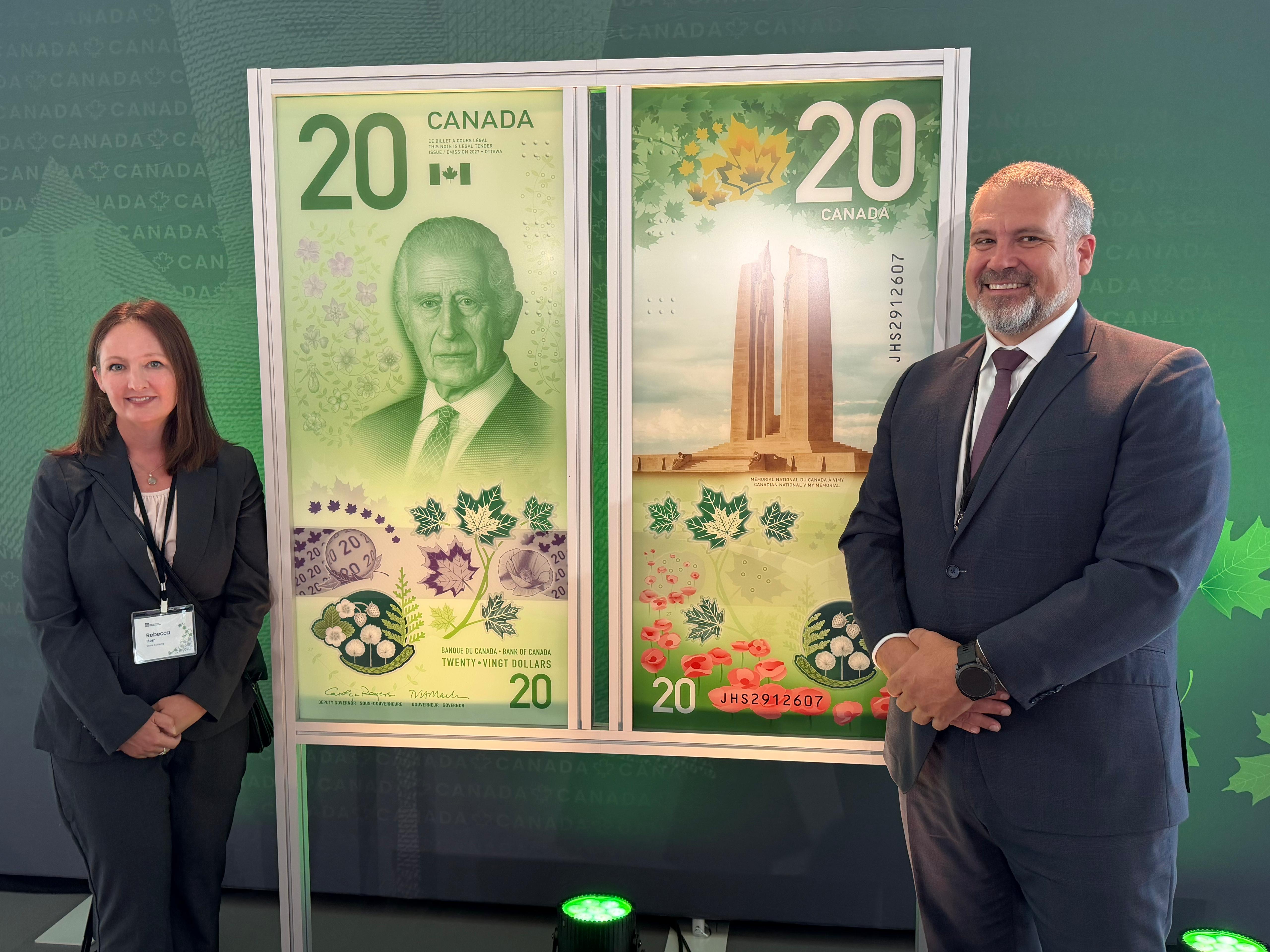
The vertical format places King Charles III within a tapestry of leaves and flowers representative of Canada's 13 provinces and territories. The reverse retains the Canadian National Vimy Memorial, preserving an important element of the existing $20 design.
From Holographics to Micro-Optics
With more than one billion Canadian $20 banknotes in circulation, the upgrade represents a significant change to the public security features of a denomination widely used in everyday transactions. The new design replaces the holographic effects of the previous $20 banknote with the fluid motion and three-dimensional effects of MOTION SURFACE.
Crane Currency has supplied a micro-optic stripe measuring 18 mm in width that serves as the banknote’s primary public security feature. Integrated into the design as a purple stripe, it combines several visual effects that respond when the banknote is tilted, giving people distinctive details to look for when verifying its authenticity.
Meet the “Bubble”
The Bank of Canada has named Crane’s three-dimensional Topo effect the “bubble” on its new $20 banknote, reflecting the language participants used during public perception testing. The effect creates a spherical form that appears to rest on the surface of the banknote and magnify the 20s within it.
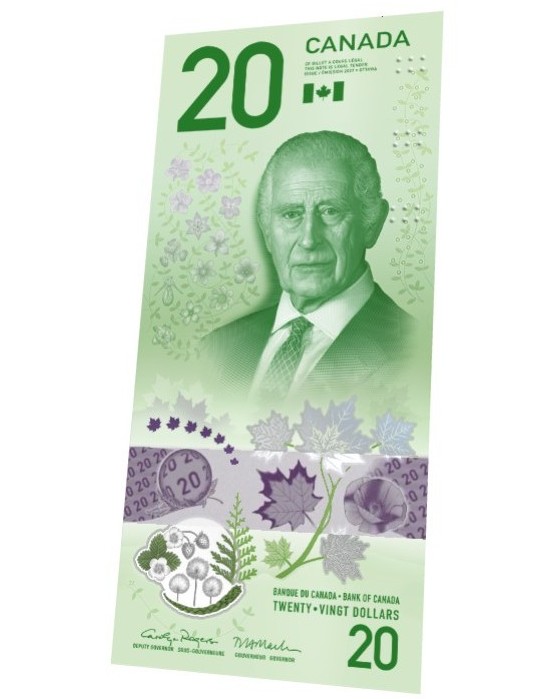
Elsewhere in the stripe, a maple leaf pulses, bands spin within the petals of a poppy, and a background of numeral 20s transform into maple leaves. These familiar symbols integrate the security feature with the banknote’s overall design while giving users clear visual cues for verifying authenticity.
Explore the full set of security features.
“The Bank of Canada has good reason to be proud of this banknote,” said Herr. “Not only have they methodically selected, customized and integrated an advanced suite of security features, they’ve conducted public engagement sessions to refine their approach to design and public education.”
The banknotes were produced by Canadian Bank Note Company, Limited on CCL Secure’s GUARDIAN™ polymer substrate. The note also features SICPA’s SPARK® Flow technology on the reverse, where gold maple leaves appear to pulse as the note is tilted.
Building on Experience
MOTION SURFACE has previously been selected for banknotes worldwide, including Aruba’s 2019 series, Fiji's Polymer Series, and Kazakhstan’s 2025 commemorative 1,000-tenge banknote. In every case, the feature exhibits visual effects tailored to the banknote’s design and national imagery.
The technology can be used on both paper and polymer banknotes. Its selection for Canada’s $20 banknote brings that proven capability to a high-volume denomination at the center of the country’s daily cash use.
The Bank’s decision followed years of research into security and public perception, assessing both resistance to counterfeiting and how people recognize and respond to security features. For a banknote handled so frequently, those features must be easy to identify and verify.