Insights
Doug Crane and the Transformation of Banknote Paper
When Paper Became Precision Engineered
Paper can appear fixed and predictable once it has become a banknote. In production, it is neither. It stretches, contracts, and responds to the conditions around it – a complication for any papermaker, but a defining challenge when a watermark must align with a printed design in exactly the right position. Few people understand that challenge better than Doug Crane. He has worked at the intersection of science, manufacturing, strategy, and government relations, and his stories help explain why Crane Currency remains at the forefront of the industry after 225 years.
“Paper is like it’s living and breathing,” he says. “A sheet travels through a machine, takes up moisture, dries, stretches and settles. That movement is part of the material’s character. It is also a manufacturing challenge when the sheet will carry security features that have to register precisely with a banknote design.”
Doug officially joined Crane in 1987. He held several management positions before leaving the company in 2013 as Vice President of Business Development and Government Relations at Crane & Co.
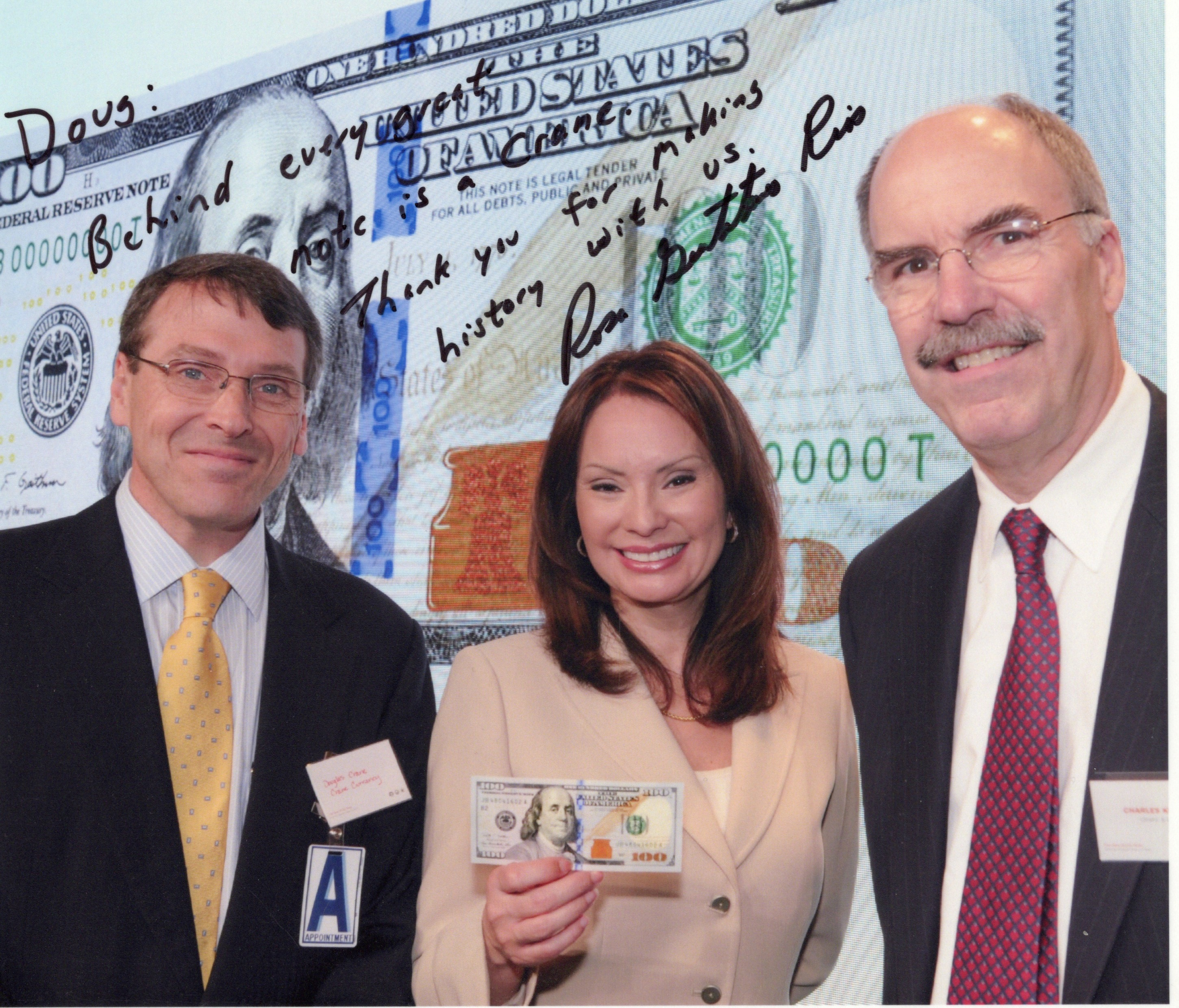
For Doug, the attraction to paper was not simply inherited. He grew up in a family with its roots closely associated with the business, but his early studies were in engineering and materials science, with an eye toward biotechnology. Returning to New England, he found himself drawn instead to the science of how paper is made – the interaction of fiber, water, heat and pressure that turns an aqueous suspension of cellulose into something strong and enduring.
“I was really drawn to the world of papermaking,” he says. “It was the sheet-forming process that I absolutely fell in love with.”
That curiosity would prove useful at a moment when Crane was being asked to make paper do more. During his career, the company’s work with governments and central banks expanded from providing durable cotton-flax substrate to addressing interdependent material, process and security challenges. The U.S. currency program in the mid-1990s would become a pivotal example.
A Sheet That Could Not Drift
For many years, U.S. currency paper could be made as a single grade, cut into sheets, stacked and sent to Washington. The redesigned $100 note in 1996 changed the equation.
It introduced a portrait watermark along with other new security features. The watermark had to appear in the right place perfectly framed by the printing that would follow. The paper was no longer just a flat surface that received the printed design. It had become an active part of a three-dimensional security product.
That requirement exposed a basic fact of papermaking. Even a well-made sheet is not perfectly static. In a conventional finishing process, sheets were cut, stacked and trimmed in quantity. Small variations in the sheet could remain. For ordinary paper products, that was manageable. For currency paper with a registered watermark, it was not.
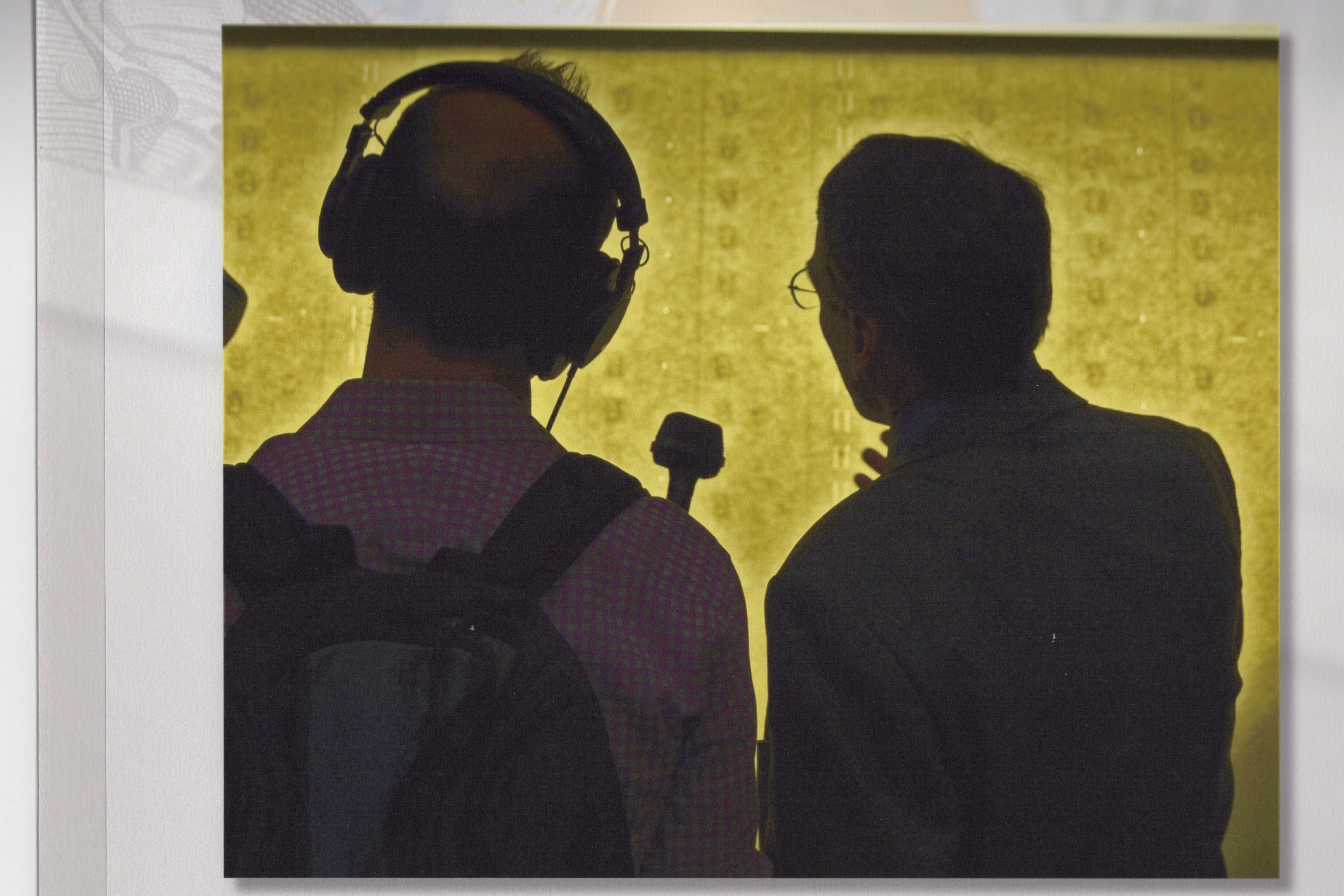
Doug worked with equipment makers, engineers, and Crane’s own finishing teams on a purpose-built way to deliver on new requirements. Rather than relying on a conventional single-cut approach, the system made dual cuts that registered the watermark position precisely in a sheet cut to proper length, at high speed and while inspecting every individual sheet for a range of defects.
The scale of the challenge makes the importance of the solution clearer. A typical finishing line might have required around ten people after the sheeter. Doug recalls that producing the new U.S. currency paper with a conventional manual setup could have required an operational staff of 600. A new system was not an improvement of marginal efficiency, but a program enabler.
As Doug puts it, Crane became “a high-tech company that also made paper.”
Technology That Began with Listening
The finishing system was one part of a broader transformation. New currency paper demanded better control of thread insertion, more precise positioning, new sensing and inspection capabilities, and close coordination with the printers who would convert the most advanced US currency paper ever into billions of Federal Reserve Notes. The work advanced boundaries of paper science, machinery, quality assurance, and the customer’s operations.
Doug sees a connection between how Crane has treated its people throughout the years and how it approached addressing the evolving needs of its customers. Stories were passed down about the company helping employees with medical bills, housing, and other needs during difficult times. But respect was also visible in the everyday work of the mill.
Papermaking was too complex, and the knowledge of the people running the machines too valuable, for a manager simply to walk in and start issuing orders. Progress depended on listening, sharing experience, and solving problems together. In Doug’s view, the same principle shaped Crane’s customer relationships. The company did not simply deliver paper and step away. It worked alongside the customer until the entire system performed as the needs demanded.
That approach became visible during an early production challenge. The paper arrived in Washington in good condition, but the press teams needed a more reliable way to prepare and handle the stacks for printing. Crane’s finishing specialists worked with them to resolve the issue. It was a small, unglamorous adjustment – exactly the sort of detail that allows a complex system to perform reliably.
For Doug, the U.S. $100 program remains the work in which he takes the greatest pride, not because it represented a single breakthrough by one person, but because it brought together so many disciplines. It required Crane to anticipate the program’s needs, build capabilities before they were required and deploy them well before their use became routine.
Doug remembers a piece of advice often heard around the company: “Be ready, anticipate what is coming next, and keep your ear to the rail.”
For Crane, readiness did not mean predicting a finished solution. It meant being close enough to customers, materials, and production to recognize the next problem early.
The Next Security Challenge
The 1996 US Currency redesign was not the end of that transformation. A later phase of work on the $100 note presented a different challenge – turning micro-optics into a public-facing security feature that was both technically sophisticated and immediately understandable.
Customer feedback repeatedly sent the team back to refine the technology. The effect was promising, but not visible enough. Doug recalls that a wider, six-millimeter window helped, but the imagery lacked distinctiveness. Greater resolution created new demands on materials, manufacturing, and process control. Each improvement exposed another problem to solve.
Tim Crane played an important role in recognizing micro-optics as more than a single product idea – he saw its potential as an entire technology platform. Doug’s perspective reveals the other side of the achievement: the years of customer dialogue, technical iteration, and industrial development required to turn that potential into a feature the public would use the world over.
The work helped open the path to MOTION® micro-optic security thread, referred to as the 3-D Security Ribbon by the US government, to be introduced into the 2013 Series $100 Federal Reserve Note.
A Watermark as a Question
Creating a new family of US currency watermarks reaches back to Doug’s earlier work on sheet formation. He had studied ways of forming paper with very strong fibers, asking whether a sheet could remain durable while still carrying a more dimensionally deep portrait watermark. A promising project was later set aside as priorities changed and research budgets tightened. The question, however, never lost its pull.
“If someone asked me to pick up that project again, I would love to,” he says. “But I’m retired and those days are gone.”
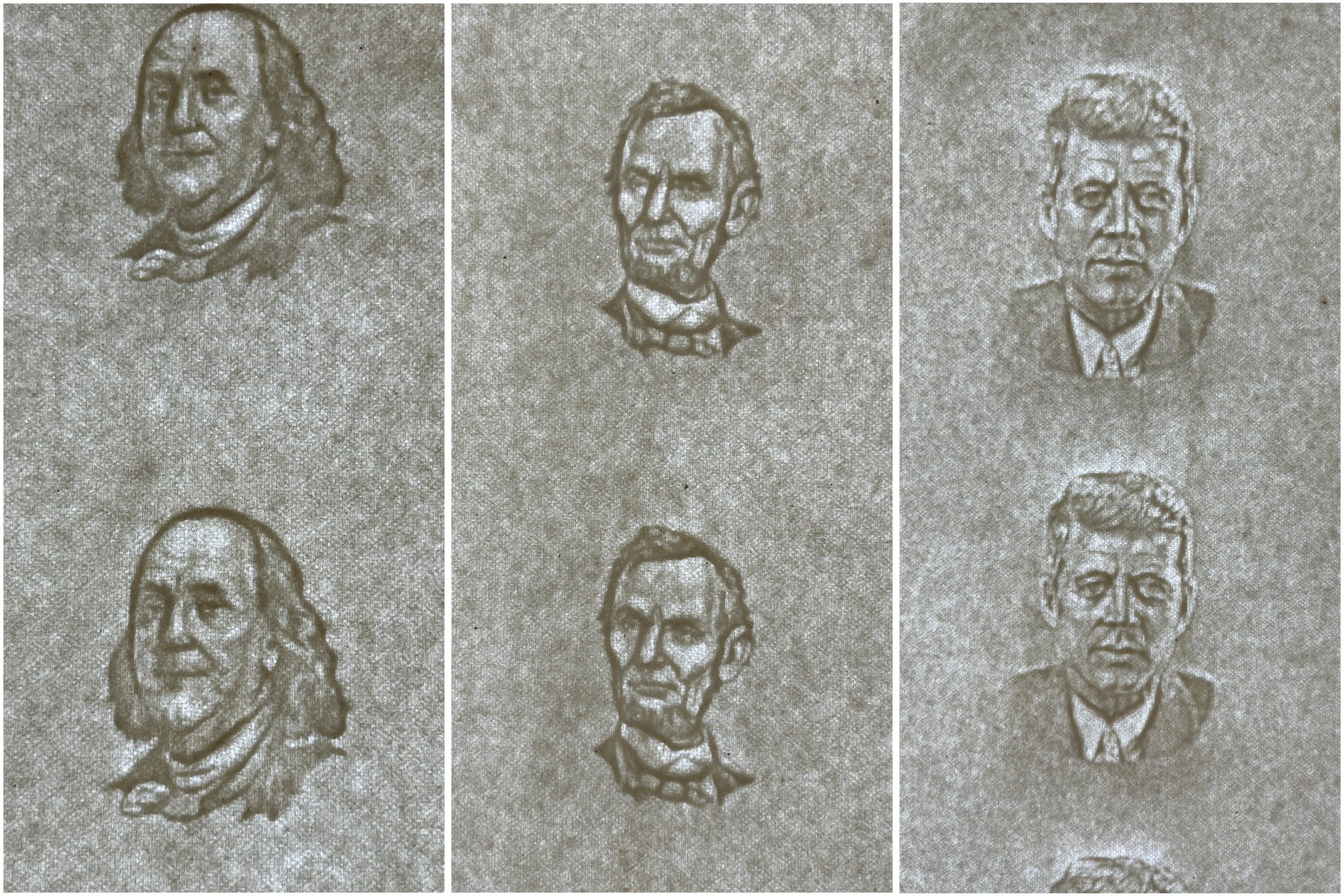
Instead, he now collects examples of older handmade watermarks. They are not simply historical curiosities. They reflect the same practical interest that has followed him throughout his career – how a design can be built into the sheet itself, how light reveals it, and how the structure of paper can carry information without announcing itself. For a banknote, that quiet quality matters.
What the Fingers Know
“The tactility of U.S. currency is the primary security feature,” maintains Doug. “But no one talks about it.”
It is a deliberately provocative way of describing something most people experience without thinking. The sensation begins with the fibers – the cotton-and-flax substrate provides strength and durability, while its interaction with immensity of pressure delivered by intaglio printing gives the note its distinctive texture, the feel of money.
Most people never think of a dollar as an engineered object. They simply handle it. Yet in that instant, their fingers are already testing the note – its resilience, the slight roughness created by intaglio printing.
People know what makes a dollar feel like a dollar, even if they cannot explain why. Their fingertips have become part of the authentication process because generations of papermakers, engineers, printers, and customers worked together to build those signals into the note.
After 225 years, that may be one of Crane’s quietest achievements – trust engineered into paper and recognized by touch.