Insights
The Evolving Challenge of Movie Money
From Movie Prop to Fast-Growing Counterfeit Risk
We’ve all seen it – stacks of cash changing hands in films and TV dramas. But today, movie money is no longer confined to the screen. Readily available online, these imitation notes are increasingly being adapted and integrated into more complex counterfeiting processes. For central banks, it is a growing and increasingly complex technical challenge, requiring a deeper understanding of how these notes are produced, modified and put into circulation.
In its simplest form, movie money is sold openly, often labelled in large print as imitation currency. But once it leaves the original seller, it can pass through several hands – each adding new elements intended to make the notes appear more authentic.
In some cases, opportunists attempt to use these notes with minimal or no modification. More organized and often networked criminal groups go farther by introducing trigger features, holographic elements or metallic foils, that quickly transform low-grade props into convincing counterfeits.
This multi-step process makes detection by the public more difficult and shifts movie money from a novelty into what some say is the largest banknote counterfeiting threat seen in decades. It is evolving into a process of incremental value-addition – from broader substrate selections that include both paper and plastic polymer, to better printed color and image fidelity, to the application of emulated optically variable devices (OVDs) – efforts by different actors are combining and scaling to produce highly deceptive counterfeits in large quantities.
"Each note has watermarks, and holograms, and passes the light detector test."


Thinking Like a Counterfeiter
 Crane Currency keeps abreast of this evolving threat by understanding how the public authenticates cash, i.e., in less than a second, and by thinking like a counterfeiter. Nick Pearson, Crane’s Principal Currency Technologist, describes this mission as understanding how counterfeiters leverage an understanding of how the public use cash against their mission of making counterfeit banknotes as quickly and realistically as possible.
“My job is to think like a counterfeiter and see how far I can push it,” says Nick Pearson.
With a background in counterfeit risk analysis developed during his years at the Bank of England, Nick works closely with central banks and Crane’s internal teams to study both counterfeits and simulated security features produced in controlled environments.
“We rely heavily on real banknote samples coming back from circulation, and counterfeits supplied to us by central banks. Internally, we work with so-called house notes to understand the counterfeit resilience and value of security features,” he explains.
This combination of real-world evidence and controlled testing provides insight into how counterfeiting techniques are evolving and where vulnerabilities may emerge.
An Evolving Counterfeit Landscape
The tools and methods employed by counterfeit analysis have remained consistent over time, while the techniques and materials used by criminals continue to develop. According to Nick, one of the most notable trends is the increasing sophistication of emulated OVDs applied to otherwise low-quality prop notes and movie money.
Holographic effects and metallic elements, for example, are no longer limited to crude imitations. Instead, some counterfeiters are now sourcing holographic patches or commissioning specialist suppliers to create stick-on features having convincing visual effects. Many of these are commercially available and widely used in other industries, making them accessible in large quantities.
In some cases, these emulations can appear more visually distinctive than genuine features, as they are applied differently in the production process.
At the same time, materials that were once considered barriers are becoming less of an obstacle. Polymer substrates, for example, have historically deterred less sophisticated counterfeiters. Today, polymer is no longer a meaningful barrier for determined counterfeiters as techniques for working with plastic films become more available.
How the Industry Responds
Perhaps the most nefarious element of this evolving counterfeiting threat is criminals targeting of a banknote’s key Level 1, or ‘trigger’ feature – a security element that should be the go-to feature on which the public relies for reassurance that the note is genuine. These directly affect how easily a note can be authenticated in everyday use. Emulation of these is testing not only the resilience of these features but how they are integrated into the banknote design.
Despite these developments, some security features continue to demonstrate strong resilience against counterfeiting.
Micro-optic technology, for example, remains highly resistant. According to Nick, these features have not been successfully counterfeited, making them a key component in modern banknote design.
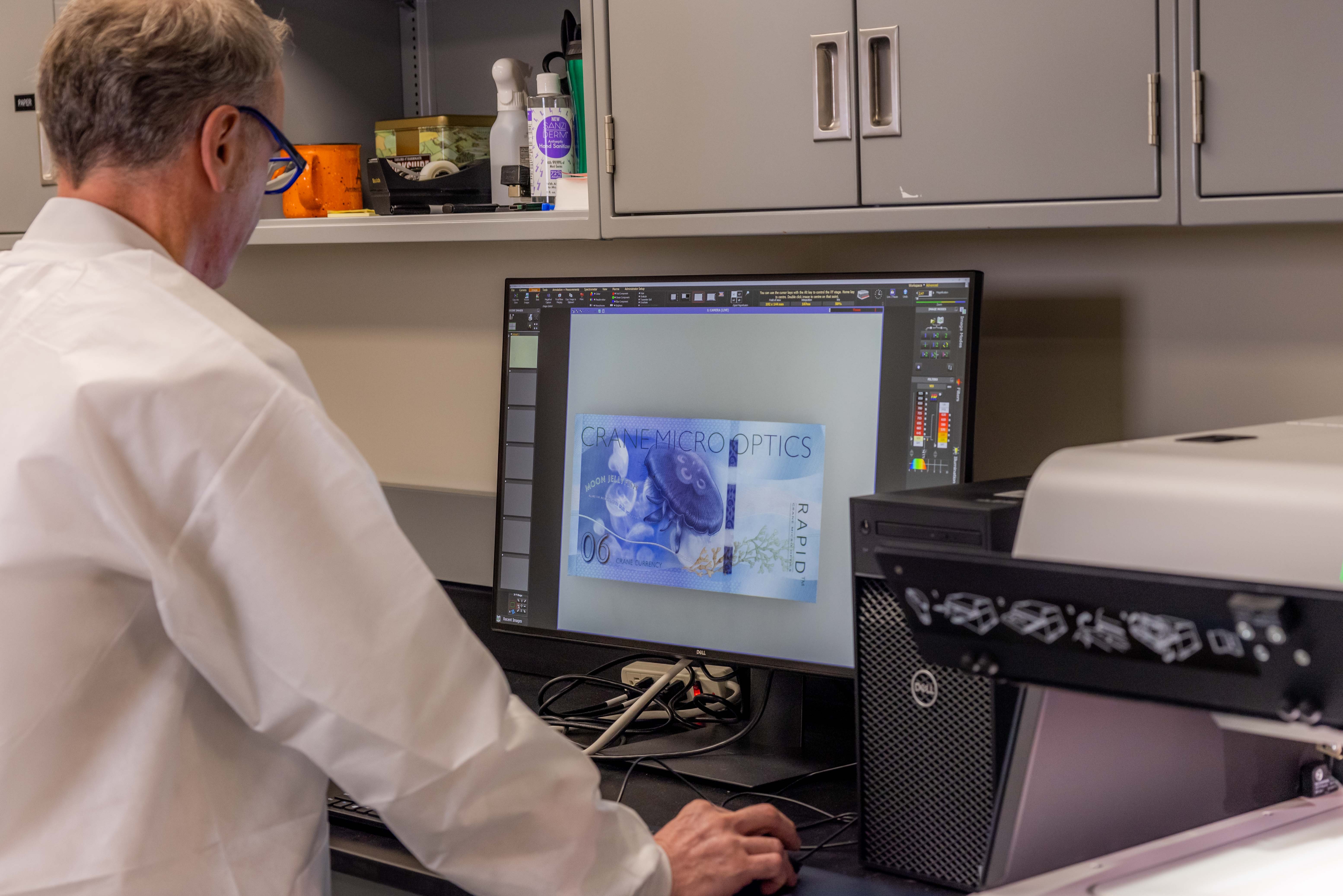
Watermarks, meanwhile, remain one of the most recognized and trusted features among the public. Their effectiveness lies not only in familiarity, but in the complexity of their production, which requires specialized equipment and processes that are difficult to replicate outside dedicated banknote manufacturing environments.
“A good watermark remains a very strong security feature. It’s detailed, it’s visible, and it’s extremely difficult to reproduce,” says Nick. They do, however, rely on the public checking for them. That is a practice that some trigger features have over time eroded, and of which counterfeiters now take advantage.
From Awareness to Action
Assessing the value of security features and the resilience of banknote designs is a significant part of Nick’s work. With the high cost of a new banknote series and the lifespan of banknote designs averaging over a decade, central banks are more than ever desirous of assessing their exposure to emerging threats.
“I always tell customers – don’t just take my word for it. See it for yourself. Understand the risk in your own environment,” he says.
This approach has led some central banks to establish their own testing capabilities, including dedicated laboratories for adversarial analysis. By replicating potential attack methods internally, they can better evaluate the effectiveness of existing security features and identify areas for improvement. They also become more informed about the resilience and value inherent to modern banknote design.
The approach is responsive not only to current threats, but also to future threats and helps ensure that a central bank’s new banknotes stay ahead of always ingenious and increasingly capable counterfeiters. In this context, curiosity and continuous testing are not optional. They are the essential tools for designing modern banknotes and staying ahead of a threat that continues to adapt.
