Insights
Tim Crane and the Evolution of Banknote Security
From Paper Science to Public Trust
As Crane Currency marks 225 years of papermaking, security and innovation, the career of Tim Crane offers a unique perspective on how banknote security has evolved across generations. His journey reflects more than advances in materials, security features and production methods. It highlights the curiosity, persistence and problem-solving mindset that have driven innovation at Crane for over two centuries.
 Growing up in a mill town, Tim Crane was familiar with its history and values, yet he still had to find his own path within the business.
Tim belongs to the sixth generation of the Crane family, yet his future at the company was never presented as an obligation. His father, Fred Crane, then VP and Head of Research & Development, did not pressure him to join the family business. His only request was a simple one: spend a summer working in the mills.
That summer left a lasting impression.
Tim was posted to a masonry crew, a team responsible for maintenance across a sprawling campus of numerous buildings – many of which date to the prior turn of the century. Distant from papermaking and currency, the job was a portal into the culture of the company. He worked as a crew member with people who had spent decades at Crane. Some made a point to share with him stories of how the company supported employees during hard times such as The Great Depression, maintaining full employment with tasks such as planting and expanding tree plantations or painting the idled papermills inside and out.
For Tim, being a part of the Crane family did not distance him from the people around him. Instead, it instilled a sense of responsibility to understand the business and the community behind it.
“All I had to do was be myself,” Tim recalls. “I was a Crane kid, but I didn’t feel any cynicism about that from the people I worked alongside. I felt that all I needed was to be a decent human being – and I got extra credit for it.”
From Biology to Paper Science
Early academic interest in biology pointed in a direction that would ultimately fascinate, i.e., how a combination of natural materials, chemistry, engineering and manufacturing were the foundation of always-evolving currency and security papers.
The decision to join Crane came into focus during a summer far from academic pursuits. With his final year of college ahead of him, Tim motorcycled halfway across the country to Colorado, where he spent months helping build what he later described, with characteristic understatement, as building “second-rate ski area condos.”
“On the ride home, it just came to me,” he says. “Being in the family business would allow me to do the kind of work I had been thinking about, and that motivated me to make sure I knew what I was talking about.”
An advanced degree from the Institute of Paper Chemistry in Appleton Wisconsin went a long way in assuring that he did know what he was doing.
A Problem Worth Solving
By the 1980s, the Bureau of Engraving and Printing was looking for new ways to strengthen banknote security. Counterfeiting threats were evolving, and traditional approaches no longer seemed sufficient.
Tim quickly recognized that the Bureau’s dissatisfaction represented more than customer feedback. It pointed to a deeper challenge. They threatened to seek a second source of supply.
Throughout his career, Tim would return to the same instinct: start with the problem, not the technology.
Colleagues knew him as someone who enjoyed technical challenges, but who was equally interested in understanding what customers were trying to achieve. That mindset would shape some of Crane’s most important innovations.
The Bureau wanted a security feature that could help people authenticate a banknote without changing the familiar look and feel of the paper.
The Breakthrough
The breakthrough came from a deceptively simple question. What if a conventional polyester security thread could remain largely invisible in normal viewing conditions, yet reveal information when held to the light?
Working in Crane’s Dalton laboratory, Tim and his lab technician experimented with selectively etching away areas of metallized polyester to form text. Once embedded in paper, the concept offered something new – a feature that could carry information without disturbing the appearance of the note.
The first successful sample was produced using a small sheet of laboratory-made paper. When viewed normally in reflected light, the metallized thread acts as a mirror diffusing its light within the paper fibers. When held up to transmitted light, the thread graphics become visible and legible.
Soon afterward, Tim and his father Fred carried the sample to Washington, D.C. and presented it to the Director of the Bureau of Engraving and Printing.
The reaction was immediate.
“That’s it!”
For Tim, it was one of those rare moments when a complex problem suddenly crystallizes into a solution everyone can recognize.
Paul Cote – Technologist and Chief Collaborator
But the breakthrough was only the beginning. Turning an idea into a banknote feature required years of refinement, testing and industrialization. The challenge was no longer proving the concept. It was proving that the concept could be manufactured, inspected and trusted at scale.
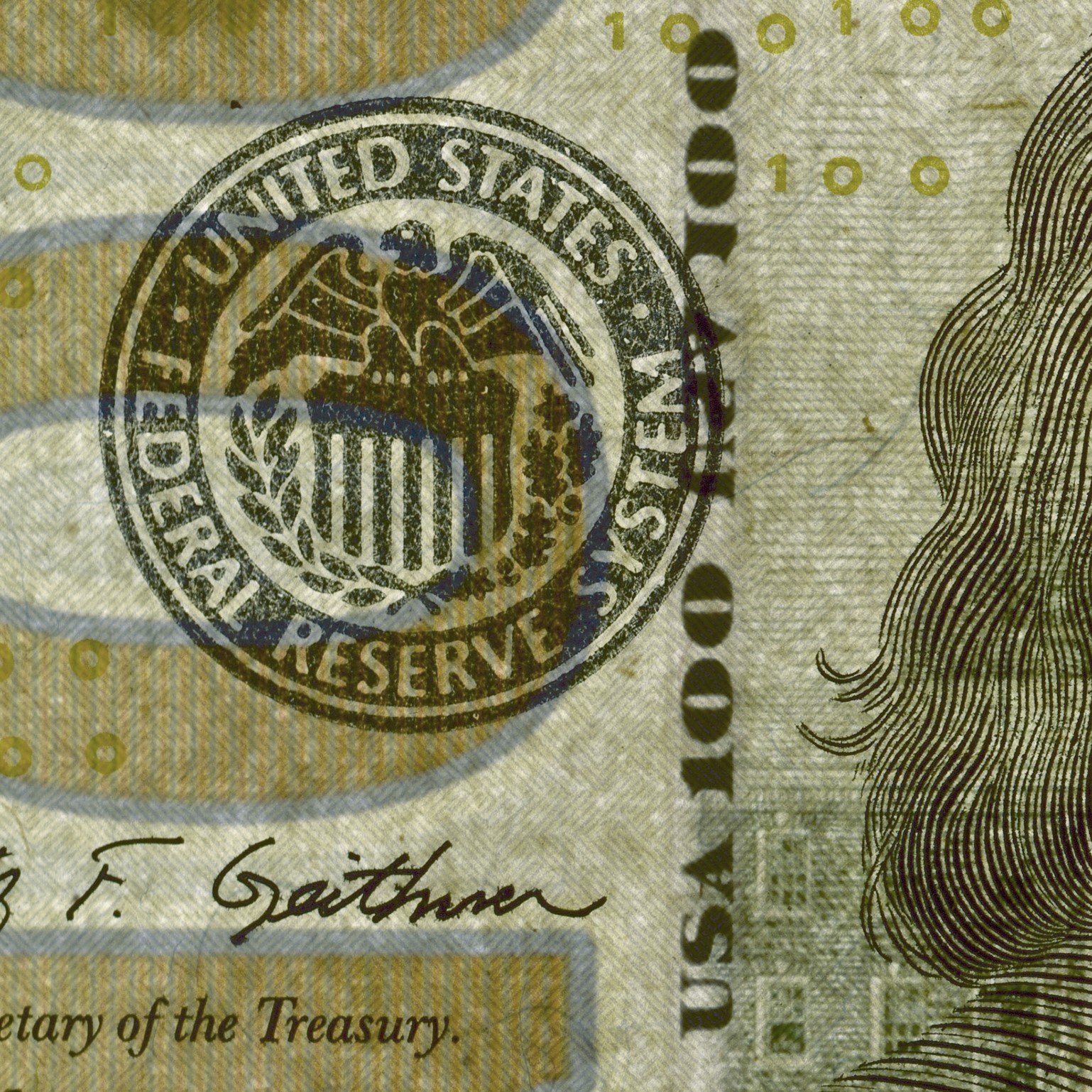 The demetallized security thread, the first of its kind, was introduced in the 1990 series U.S. $100 Federal Reserve Note, bringing a new generation of embedded security features into circulation. Paul Cote was instrumental in developing the groundbreaking demetallized security thread and in shaping the company's future anti-counterfeiting portfolio. Together, Tim and Paul established a principle that would guide future innovation: the most effective public security features combine extraordinary technical sophistication with intuitive ease of use.
Tim is very clear. “I had the privilege to stand on the giant shoulders of Paul Cote. Countless times over decades, Paul was there saving the day with some crazy improvised mechanical solution conjured up in the middle of the night and delivered to the customer the same day.”
Now retired, Paul spent around 50 years at Crane Currency, serving both as Vice President and Chief Technologist.
Recognizing the Next Opportunity
Years later, Tim experienced a remarkably similar moment as the meeting in Washington. While reviewing a strip of micro-optic material developed by Nanoventions, a pioneering technical company in Alpharetta, Georgia, he immediately saw possibilities that extended far beyond the sample itself.
“They put a little strip of micro-optic material on the table,” he recalls. “I looked at it and thought, ‘That’s it, this is not a product but a technology platform.’”
Twice during his career, Tim encountered an idea that immediately stood apart from everything else he had seen. The first helped transform security threads. The second would open the path toward Crane’s micro-optics and MOTION® technology.
Once again, the challenge was not simply the technology. It was understanding how it could be transformed into a manufacturable security feature.
With micro-optics, movement and depth became part of the authentication experience. The technology was extraordinarily sophisticated, but the user experience was simply to tilt the note and see the effect.
That simplicity was not accidental. For Tim, the most successful security features were never the ones that were only difficult to counterfeit. They were the ones that helped people intuitively recognize what is genuine.
Designing Trust
Looking back on his career, a consistent philosophy emerges. Innovation begins with a real problem. It respects materials, manufacturing and customer needs. And it recognizes that public trust is not an abstract concept. It must be designed into the banknote itself.
Today, Tim’s focus has shifted from banknote security to community service and philanthropy. He serves as board member and campaign committee chair of the Community Recreation Association of the Dalton Community Recreation Association (DCRA), a nonprofit organization that operates parks, sports facilities and community programs in Dalton, Massachusetts.
The connection feels fitting. Originally established with support from Winthrop Murray Crane, who built and endowed the CRA while serving as a US senator from Massachusetts, the CRA remains closely connected to the same community that shaped Tim’s understanding of responsibility, service and leadership.
Across 225 years, Crane has repeatedly adapted to new risks, technologies and expectations. Tim Crane’s career represents one important chapter in that larger story.
His contribution was not limited to helping develop security threads or support the path toward micro-optics. As it turned out, it was to help redefine banknote security, and to continue to help people trust what they are holding in their hands.