-
Secure Perception Research (SPR) Ltd. is a research and consulting company specializing in how people perceive and authenticate banknotes and brand-protection features. For more than 15 years, SPR has worked with G7 central banks and currency industry suppliers. The company uses behavioral testing, eye tracking, neuroscience, and computational methods to measure what users notice and how quickly and accurately they respond.
Visit Secure Perception Research
PERCEPTNOTE® - PerceptNote can assess security features and banknote designs by simulating the conditions of payment transactions to account for the human capabilities to perceive color, the denomination and use of security features. PerceptNote leverages decades of human perception research in combination with state of the art computer vision and machine learning techniques to improve the performance of banknotes.
PERCEPTNOTE® EVALUATION OF MICRO-OPTIC SECURITY THREADS
This study uses different measures to compare three types of micro-optic security threads, and shows that RAPID® security threads provide stronger, more easily perceived effects compared to other features in the study. RAPID® Vision provides stronger color contrast and further boosts engagement and authentication speed. The two Anima™ security threads evaluated showed comparatively weak greyscale contrast, virtually no color contrast, and barely detectable dynamic effects, indicating they are likely to be difficult for the public to find and judge as authentic.
ASSESSING IMPACT OF MULTICOLOR RAPID® SECURITY THREADS
This document reports the results of a user perception project directed at understanding how visual effects impact usability (speed and accuracy of verification) of RAPID® security threads. The multi-part study shows that using two colors can boost processing speed, making authentication easier without incurring any cost to accuracy. The processing speed (<500 ms) is assessed across the four phases of authentication, i.e., find, identify, check and act.
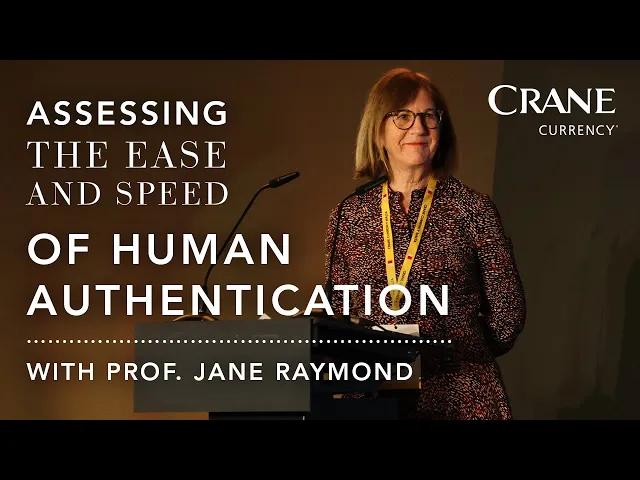
SEE THE PRESENTATION FROM PUBLIC FIRST 2023
In this Expert Learning Segment, the industry’s acknowledged banknote perception expert, Professor Jane Raymond and CEO of Secure Perception Research shows us how the public determines banknote authenticity breaking this fast, nearly reflex-like process into four key steps.
THE USER EXPERIENCE EXPLORED
The multi-part study demonstrates that the strong three-dimensionality effects of the MOTION SURFACE® stripe, i.e., ‘Topo’ effects, are capable of providing essential information for authentication with a single fixation (from 100 ms to 300 ms) and under low light levels typical of bars, taxis, some restaurants for most members of the general public. ‘At a glance’ is defined as an investigation time of 300 milliseconds.
The strong 3D visual cues also were seen to generate appropriate hand actions for accurate verification (98% of people) without any prior instructions; just under half (47%) were moved to touch the feature; perhaps to ‘test’ the illusory nature of the strong 3D effect.